Jeff-Vogel

  • Subscribe to our RSS feed.
  • Twitter
  • StumbleUpon
  • Reddit
  • Facebook
  • Digg
Showing posts with label back in the day. Show all posts

Tuesday, 5 November 2013

Marketing, Dumb Luck, and the Popping of the Indie Bubble.

Posted on 16:20 by Unknown
This article is kind of depressing, so here is a puppy hugging a kitten.
Sigh. I hate writing articles like this. Even if I’m right (and I really think I am), nobody thanks the bringer of bad news. If what I predict does come to pass, people will resent me more, not less. But I really think what I have to say should be considered by the jillions of ambitious game devs who are quitting their day jobs to go indie. So here goes.

Interesting game article in the news recently. This guy named Alexander Bruce wrote a puzzle game called Antichamber. It did very well. He just did an interview (written by Brendan Sinclair) about how it’s very important to do marketing and develop a good relationship with the press and your players.

The article contains a lot of questionable statements (by the writer, not Bruce) like …
"Just a few years ago, developers didn't need to worry so much about their relationship with the end users."
Does this match the experience of anyone trying to keep a small software company alive in the last few decades? The ability to keep a good relationship with end users was our best tool for staying alive. But I digress.

(Edit: Just to be clear, a lot of stuff Bruce says is very sharp and worth heeding, especially about how dealing with limited resources forces you to be clever.)

Despite the weird stuff, Bruce gets a bit of good advice in too. To a point.

Now, first, it's evidence how amazingly sweet things have been for indie devs for the last few years that anyone would even think "You should do marketing." is news. When I started out writing shareware in 1994, the first piece of advice anyone ever gave anyone about anything was, "Yeah. Marketing. Do that."

Not the right way to market your game.
But, Um, Duh, Right?

Isn't it kind of an obvious bit of advice? When you finish your game, you'll tell people, won't you? Is anyone trying to succeed at business by finishing their game, putting it in a lead box, and burying it in the backyard?

But here is where the article sort of falls apart. There are many paths to success in the indie biz, and each needs its own marketing plan. Each developer has their own set of strengths and weaknesses, both mental and in cash and time resources.

Just because one path (Hint: Steam) has been popular of late doesn't mean it's the right one for that particular game (since the genre you are working in will require its own strategy, depending on how niche you are), or that it will be a plausible path forever. If you are trying to make it writing high-cost, boutique games in a serious niche field like, say, turn-based wargaming, following the strategy Alexander Bruce used for his puzzle game will lead to ruin.

You see, the conventional wisdom now is that, to make it in indie games, you need to blow it all on one big, flashy title. Spend all your time at GDC giving the gaming press hot oil massages. Then release it on Steam, get fifty articles written about you, and make meelions of dollars. Buy a Tesla, give interviews, have your next game be a 2-D platformer, and die happy.

But buried in the article is the real news. The little tidbit that really says where things are going ...

"Even being featured in a coveted place like the Steam Daily Deals doesn't mean as much as it used to."

Yes. This is true. A Steam Daily Deal used to mean doing a happy dance and putting on your Super Money Pants. What? That's fading? Uh oh. And this is the beginning of the real story.

By The Way …

I’m not happy about any of this. A few years ago, there was a huge demand for indie content, and I had a bunch of quality games ready to go. I profited from this temporary state of affairs far more than I deserved. I am not gloating about sweet times coming to an end. My modest games will be the first on the chopping block.

I can't get rich selling THIS anymore? NO FAIR!
When Can We Start Using the Term "Indie Bubble"?

On October 29, Steam accepted 100 titles for publishing from their Greenlight system. A HUNDRED. IN ONE DAY. JUST ON STEAM.

This is the problem with so many indie devs cozying up to the Escapist and Kotaku and the PA Report. There is a flood of new titles, so many that Humble Bundle sells them in Costco-sized bundles of a dozen for a dollar. A lot of good titles won't ever get that press. They just can't. There's not room.

And that's just for the flashy titles (the "AAA Indies"). My turn-based, low-budget, word-heavy RPGs are a lot of fun and have a real audience, but nobody at Kotaku gives a crap about them, nor should they. Why would a Let's Play channel on YouTube want to do one of my games? It'd be like putting up a movie of someone reading a book. Alexander Bruce's marketing path is useless to me, but my business is still valid. Has been for 20 years.

Also, the gaming community doesn't care about indies as much as we like to think they do. (Minecraft is an ultra-mega-uber hit, right? Well, Grand Theft Auto V made more than it in like 18 seconds.) The gaming press knows that gamers only want to hear about so many indies. Soon, they'll start picking who lives and who dies.

The point? Any article about marketing indies that doesn't mention the word "luck" is lying to you.

Even if she was alive, she still wouldn't want to play your 2-D platformer.
By the Way, Luck Exists

I know all you young developers are brash libertarians who believe in a just, deterministic universe. So feel free to get angry at me for this part: Unless times are really good, you need luck for your business to succeed. You need the rare sort of good times where there's a ton of demand and very little product. A time like the period that is now ending.

Yes, Luck: Getting a good break. Meeting the right editor who will champion you or making the right publisher connection. My company, Spiderweb Software, has been lucky. Many times. I'm not ashamed to admit it.

Worthy titles sometimes fall by the wayside now. There is no inherent universal justice that decides that the "best" games succeed, whatever you mean by "best". Some gamers will love you, and some won’t. You have to hang on until one of those gamers becomes an editor somewhere. The more niche your product is, the longer you will have to wait.

Disagree? Think that everyone who fails only fails because they were lazy or stupid or just suck? Fine with me. It's your call if you need to believe in a universe based on justice and fairness. I hope someday to join you there.

This article is kind of depressing, so here is a puppy.
Can There Only Ever Be One Path?

Here's how it works now. Everyone makes a team, puts something together with flash, pushes the heck out of it at GDC/PAX/whatever, and waits for Steam to wave its magic fairy dust wand and make them rich.

Which is great. If it works. But there's a problem. There's still a lot of fairy dust in that wand, but it's getting spread awful thin.

Is there another route to success in this business?

You could try what I did to make a long career. You could pick a neglected genre, write the best games you can for it on a limited budget in your spare time, release one game after another, and push your work where you can to build a loyal audience with word-of-mouth and good customer support. Then, maybe, years later, thanks to your persistence and hard work, you might go full time. A loyal audience can keep you in business through good times and lean.

All you need to make a game is a $299 computer, a chair, time, and some software which we'll pretend for the moment you didn't get on BitTorrent. It will probably look cruddy, but a lot of people don't care (and many people get off on the rough DIY thing). You won't be on Steam, but there are plenty of ways to sell it like on your own site. It'll be tough, but starting a new business is never easy.

When I did it (shut up, grandpa), there wasn't even the web. Now there are forums and communities galore. There are a million places to start assembling that customer base, and you don't even need to say the word Steam.

Is this possible? It should be. It happens. I'm not the only small dev who has made a living this way. But, sadly, there aren't many. I don't know how feasible the slow and steady building of a clientele is in indie gaming. I am, however, confident that we're going to need to start finding out.

Dear God, please let Polygon notice meeeeeee!
But What About the Future?

I think we're in for an interesting few years in the computer game industry. I have my own opinion about the future of small game development, and it's this:
If your game can't succeed based on word-of-mouth marketing, unless you get real lucky, you need to adjust your budget, your quality, or both.
I know, I know. "Jeff Vogel is just being a crazy old coot again." Sure. Nobody wants to hear a whole business model being called into question.

But I've lived through rich times and lean times, several of each. Small-scale software development is a rough business, and you need to operate lean and mean to live in the long term.

Some indie devs will use their bubble money to get big and survive. Anyone who can't grow huge and doesn't have the patience and persistence to go the small company path will have to seek opportunities elsewhere.

Don't get me wrong. I don't want to see anyone lose their jobs. I've actively enjoyed seeing people who do what I do getting rich.

However, Microeconomics 101 is still true. When people start making a ton of money, they will attract competitors until nobody makes easy money anymore. It’s an iron law of capitalism.

Alexander Bruce deserves his success, but it is important to remember that the path he described in his interview is only sometimes the best way, even if the press often treats it as the One True Route. Not everyone can market their way to success.

(Edit - The final sentence was perhaps a bit too hostile, so I changed it.)

---

My incoherent mumblings are now available in condensed form on Twitter.
Read More
Posted in advice, back in the day, business stuff, everyone will hate this, flamebait, indie, steam, whistling past graveyard | No comments

Wednesday, 8 February 2012

My Life's Tour Through Dungeons & Dragons, Part 1.

Posted on 19:26 by Unknown


I will never, ever forget that day in fourth grade. It was recess, and, as all the other kids ran outside to play, a few of the boys pulled out sheets of paper, some odd-looking dice, and a thin blue book with a dragon on the cover. I asked what they were playing. Something called Dungeons & Dragons. I asked if they would teach me. They said yes.

It was at that moment, to borrow a phrase from Stephen King, that I put my hands on the lever of my destiny and began to push.

(You may expect a self-deprecating joke at this point, something about how I played it until I discovered girls, or something like that. If you expect any signs of shame in my D&D obsession, you have come to the wrong damn blog. And I only dated girls who enjoyed playing the game with me, thank you very much.)

I almost never play tabletop RPGs anymore. I would like to, and my friends have been nagging me to run a game for years. But adult life, especially when you are a parent, is merciless. Happily, I will someday be retired, and then I can run all the campaigns I want for any D&D fans who are still alive.

The recent announcement that they were starting work on 5th edition D&D made me think back happily on all the different flavors of the game along the way. Come! Join me on a little tour through Back In the Day ...

Dungeons & Dragons (White Box Edition, 1974)

Never played it, as I was practically an embryo. I have read the rules, though, and they read like they were dictated during a fever dream.

First Edition (1977)

Which is to say, Advanced Dungeons & Dragons, as opposed to the Basic Set, or the Expert set. Things got a little confused back then.

Old people like me look back with great nostalgia on early D&D. This is the version I've spent the most hours playing, and remembering how exciting and new it was tends to make us forget the problems the game had.

Enormous, epic problems, caused by the fact that its creators didn't have decades of RPG design to draw from. Don't be fooled by the mutterings of the grognards. First Edition was only playable with piles of house rules and plenty of spit and duct tape. Everything about it was rough.

What was wrong? Where to begin… how about that new wizard characters (called "magic users," in a glorious lack of poetry) could only cast one spell a day. These players spent the rest of their time running to the store to get chips and Coke for the kids who were actually doing things.

Or how, when a poisonous monster bit you, you had to roll a high number or your character just died. What? You rolled a 7 instead of a 12? That's it for you. It must suck to be such a terrible player.

Or how most undead, when they hit you, drained your levels away permanently. It was as dreadful as it sounds.

It was, in gamer-speak, super hardcore. And you know something? Sometimes I miss it. You were genuinely scared of monsters back in those days. It was exciting. And, now that I think about it, characters should die more often. It makes things more exciting, and you get to try lots of different classes.

In the end, after years of play and feedback, it was clear that much had been learned and that the rules should lead to a lot more fun. Thus, Second Edition.

(To be continued in the next post.)
Read More
Posted in back in the day, dungeons and dragons, humor | No comments

Wednesday, 27 July 2011

Announced ... Avernum: Escape From the Pit

Posted on 23:43 by Unknown

This blog has been sadly neglected lately, due to a combination of vacations and a frenzied effort to get our newest game to a point where we could officially announce it. But that day has arrived. Drop by our web site and take a look at Avernum: Escape From the Pit!

This is the second time that we have rewritten the Exile/Avernum trilogy, a move that is full of all sorts of questionable integrity. I am very nervous about announcing this title for exactly that reason, even though we have very, VERY good reasons to do a serious, polished rewrite of this game. Because Avernum has such a large and passionate fanbase, we have already put up an Avernum: Escape From the Pit FAQ to answer many of the questions that will be coming up. Such as, Why?

Short answer: Because the old version doesn't run on new machines anymore. Also, the iPad.

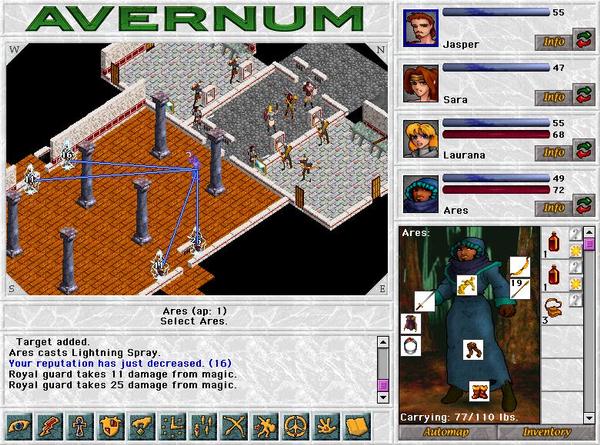
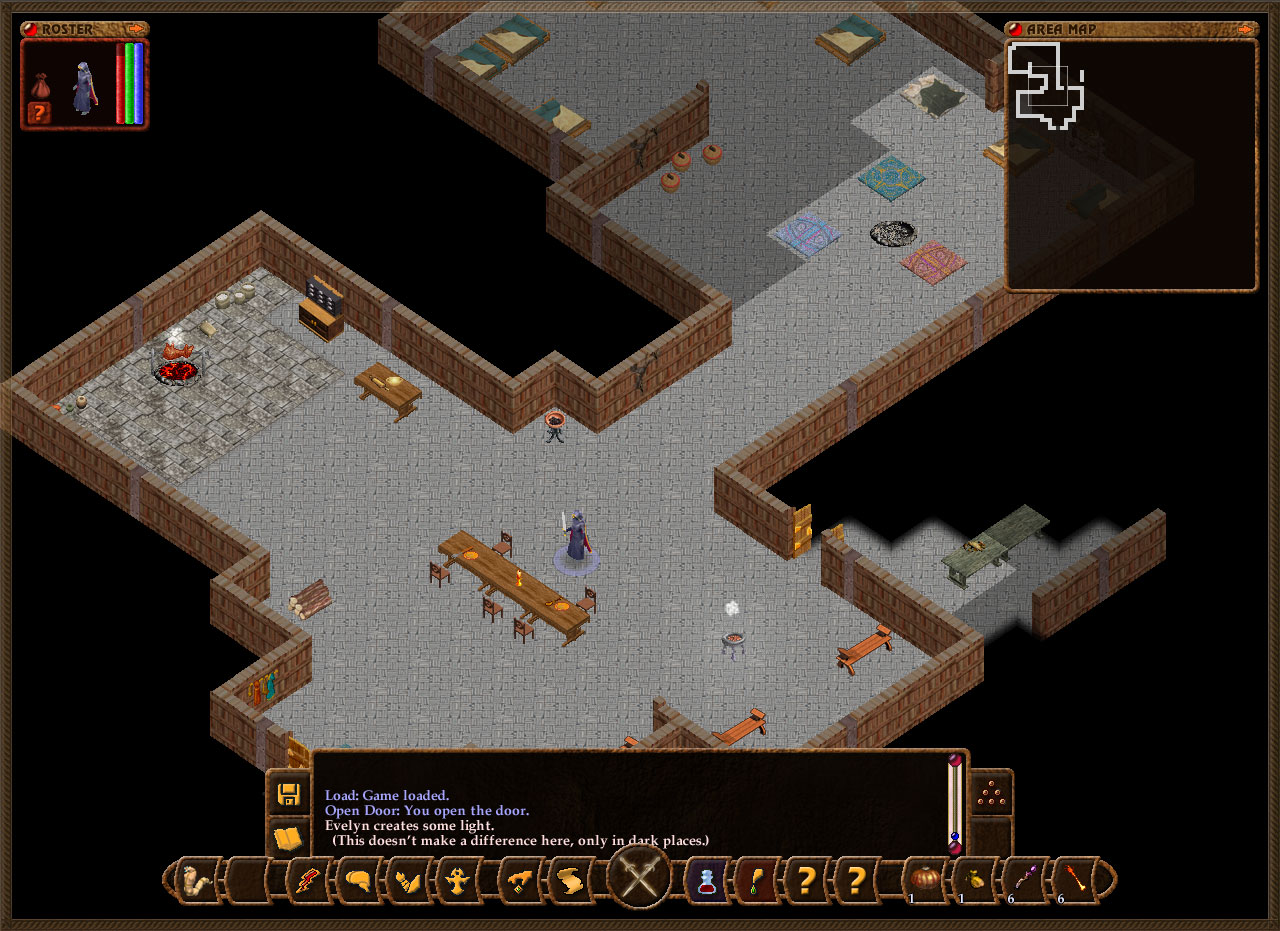
Longer answer. Look at this screenshot from Avernum:


Ghhhhahhhhh! Make it go away! Make it go AWAYYYYYYYY!

I mean, seriously.

We've been very determined not to half-ass this adaptation, and, when all is said and done, we will have put almost as much time into it as into a whole new game. It's been a little rough, and yet, I don't see how I had a choice. The first Avernum trilogy is my first creation and still one of my most beloved, and if we didn't rewrite it then it would have just disappeared. I can't abide that.

Other terrifying decisions. For the first time ever, we will be selling a new title for $20. When we released our first game, wayyyy back in 1995, we charged $25. At the time, that was a fair and unsurprising price for a shareware game. These days, the constant downward pressure on prices can no longer be ignored. Also, the market is developing in ways that finally make me think that we can make more money at lower prices.

I now hope to return to a sensible and semi-regular blogging schedule. For example, soon I will write a sort of review of LA Noire. Before I can write it, I want to see if the game ever has a murder victim that isn't naked.
Read More
Posted in avernum, back in the day, omigodomigodomigod, shameless self-promotion, spiderweb software | No comments

Thursday, 10 March 2011

The Whittling Part Of the Brain

Posted on 16:56 by Unknown
(One of the reasons I started this blog, besides pimping my games, was to resurrect some of my old writing that has disappeared from the face of the Earth. For example, about a decade ago, I wrote a column for the late, lamented Computer Games Magazine called The Grumpy Gamer. Here it is, only slightly updated.)

(This was the first column in that series, and, while its basic idea is simple, I still think this piece or writing is True. What still fascinates me is the way some people feel that their way of resting their brain makes them oh so superior to people who rest their brains in a different way.)


The Whittling Part Of the Brain

I have spent the last several years of my life designing computer role-playing games for a living. Thus it came to be that after a friend of mine, who designs board games for a living, couldn’t figure out why anyone found Everquest to be the slightest bit fun, he came to me for an explanation.

For those of you who haven’t experienced this particular brand of delight, most of the Everquest experience tends to involve waiting next to a place where wimpy monsters appear, waiting for them to appear, butchering them once they do appear, collecting their loot, and repeating this process until it’s five in the morning. For the uninitiated, this looks, let us be frank here, like a big waste of time.

But, when he asked me why anyone would want to do this, I had an explanation ready. It’s the same explanation I give whenever anyone asks me what the point of playing computer games is. I simply say that computer games satisfy the Whittling Part of the Brain.

Some of you, in this advanced, techmological age, may not be familiar with the concept of whittling. To whittle, you sit down with a knife in one hand and a stick (or other piece of wood) in the other. Then you take the knife and systematically proceed to carve thin slivers of wood off the stick until there’s nothing left but a pile of wood shavings and your own sense of deep self-satisfaction.

(This sounds, of course, like a pretty dubious source of entertainment, but people do some pretty bizarre things to kill time. Like watch Jersey Shore, for example.)

Of course, this sort of thing is what people did before computers were invented. Or televisions. Or fun. Nowadays, people can do all sorts of low-thought things to pass the time. Knitting and needlepoint. Crossword puzzles. TV. Reading mystery novels. Playing Minesweeper. And playing computer role-playing games.

The human brain just seems to have a need for resting, for passing some time in a low-energy state. Computer role-playing games are perfect for that. When I fight fifty basically identical combats against darkspawn in Dragon Age or spend five hours finally getting my level 13 druid in World of Warcraft to level 14 or piled a hundred bricks on top of other bricks in Minecraft, I’ve done more than waste my time. I’ve given by brain rest that, for reasons I can’t begin to understand, it craved.

And, of course, some of my friends think that I’m wasting my time, both designing the games and playing them. The same friends who don’t think twice about doing their five thousandth crossword puzzle, or reading basically the same damn mystery novel for the billionth time. Or read The Onion, like that’s such an enriching activity. People just like to fritter time away, and computers give us an unusually satisfying way to do it.

The most important thing about these low-brain activities is that they have to be rewarding in some way. They have to give us occasional positive feedback, little flashes of satisfaction. Sometimes, when whittling, you might carve away a particularly long and attractive spiral of wood. (Yeah. I know. Just bear with me on that one.) When knitting, you have the satisfaction of finishing your sweater. With a crossword puzzle, you feel smart when you finish.

And when playing a role-playing game, you get a constant, pleasing form of feedback in the form of gold and experience points. Or upgrading from a +1 to a +2 sword. Or getting a new spell, or completing a quest. Everquest is particularly cunning in the way it rewards the player. It has the character’s skills constantly creep upward, a tiny bit at a time, providing a constant stream of tiny rewards.

Now sure, when described this way, the whole activity sounds a little sad and lame. But really, when you think about it, if it’s such a pointless activity, why do we want to do it? I have found that, in general, our brains our smarter than we are. They want what they want, and if my brain wants to spend a while in front of a computer screen stabbing orcs, who am I to tell it it shouldn’t?

So there you go. In just the first column in this series, I’ve come up with a complete, comprehensive explanation for why it’s good and healthy and productive for us to like to play computer games. And I will recite it to myself, again and again, at two in the morning, when I’m lying awake trying to convince myself that I’m not wasting my life.
Read More
Posted in back in the day, grumpy gamer, i've wasted my life | No comments

Friday, 24 September 2010

The Ugly Truth About Classic Games. They Are Terrible.

Posted on 11:07 by Unknown
It's no secret that I love classic games. My games are all, in some way, tributes to classics. I have a huge personal collection of old Atari 2600/5200/7200/Intellivision/Colecovision/Vectrex/Astrocade/Odyssey 2 cartridges. (All in good working order, thank you.) That you can still buy old Atari games in stores and on XBox Live, among other places, warms my heart.

But let's not put too fine a point on it. They are not, for the most part, fun. One of my favorite things about my classic games collection is my ability to keep having this conversation with my friends:

"Oooh! Old games! I loved Pitfall! Do you have Pitfall?"
"Of course."
"Can I play it?"
"Sure."
(Five minutes pass.)
"This isn't any fun."
"No, it's not."

I have this huge collection of old games, but I spend all my gaming time with my XBox 360 or PS3. (Or, on increasingly rare occasions, my Wii.)

The reason I bring it up is because of this fascinating article about the unquestionable classic, that inspirational breakthrough, that great of greats, Ultima IV.

Basic summary: Professor teaches class on classic video games. Makes students play old games. Goes all right until they try Ultima IV. They find it to be opaque, dull, and completely unplayable.

Well, YEAH.

Look, nobody worships at the altar of Lord British more than me, and you can't put into words what a breakthrough Ultima IV was at the time. It set me on the path to writing games for a living. I played it again and again. It literally Changed My Life.

But it isn't playable now. The controls make no sense. The dialogue is bland. All of the little UI tricks that make RPGs accessible (tooltips, in-game maps, pathfinding) were not yet invented. And, and this is really important, everything that Ultima IV introduced everyone has done far better. Ultima IV had an epic quest and morality woven into the game, which was amazing at the time. But everyone does those things way better now.

So it's been years and years since I've recommended anyone play a game with Ultima in the title. Or, if they really want to try a game in the series, I recommend Ultima VI, which is awesome.

I like looking back to the past. Nostalgia. History. And there are some old designs that really should be modernized. (Archon. M.U.L.E.) But, hey, classic gaming back in the day? Pong? The Atari 2600? Man, I was there. It's better now. Wherez mah Halo?

Oh, and I will finally know that we have shaken off the dust of the past when it is no longer possible to play Joust. God, but I hate Joust.
Read More
Posted in back in the day, everyone will hate this, flamebait | No comments

Thursday, 13 May 2010

Three More Tips For Getting Started In the Indie Gaming Biz

Posted on 17:46 by Unknown

In February, I wrote my first three tips for getting started in the Indie gaming biz. I am starting to feel old and outdated in this business, so I feel like I'd probably be better off not trying to act wise. Sometimes I get e-mails from successful Indie developers, telling me what an inspiration I was to them when they were young. And then my skin starts to peel off in sheets and my hip spontaneously breaks.

And yet, there are still several more bits of advice that I think are genuinely helpful.

4. All Relevant Laws Apply To You

If you are trying to run an Indie game business, you are, first and foremost, running a business. All local, state, and federal laws apply.

You need a business license. Or licenses. I, for example, need one license for Washington state and another for Seattle. Go to your local bookstore and get a book on starting a small business wherever you are. Read it carefully, take it seriously, and get all your paperwork in order.

Every business should have a lawyer and an accountant. I personally have done without having a dedicated lawyer on tap (an unwise course), but every business should have a skilled accountant. This is very important. You have to fill out your tax forms, and an accountant will help you to do so in the safest, most beneficial way possible. Do not neglect this! If you screw up on your taxes, no matter how innocent your intentions, the best you can hope for is that your auditor will give you a sympathetic shake of his head before he destroys you.

You should try to get liability insurance. People sue each other for crazy reasons. It's good to have protection. Sadly, I have found that, as a game designer, liability insurance is hard to get and expensive. This should be taken as a measure of how high your legal risk in this business is.

5. Respect the 90/10 Rule.

Ten percent of the work takes ninety percent of the effort.

When you are designing your first game, putting things together in your spare time, you will probably have a lot of ambition. When you are actually writing it, it will be a thrill. Things are moving. Creation is coming together. I'm doing it! I'm really doing it!

Then, at some point, you hit a wall. You start testing, and there are a million bugs, and fixing them is not fun. Your first spurt of energy is starting to flag, and there are still a ton of levels to design. And, perhaps, the trickiest game systems still need to be done.

So be wary. So many promising projects die at the 90% mark. When designing your game, try to estimate how long each step will take. But, as you do so, also pencil in months of time chasing bugs, fixing broken systems, and doing the grinding polish work that will make your game stand out. How long everything will take to do should be a key factor to take into account when deciding what will be in your game. If this process makes you realize that your initial design concept was too difficult or ambitious, start losing some of the unnecessary elements earlier rather than later.

6. Find Good, Cheap Online Resources, But Make Sure You Have the Rights

Oh, how much time I would have saved if, when I first started out, I had the awesome resources that are available online now. For someone whose games are as retro as mine, it may seem odd that I am suggesting you get graphics and sound effects where I do. And yet, you will need all sorts of assets, and I can recommend a lot of good places to start looking.

When you find resources online, be sure that you have the rights to use them in a game. This can save you a lot of hassle. When I was writing Exile 2: Crystal Souls in 1998, a friend gave me some awesome sword effects he found online. They were great, so I used them. Then I got the Cease & Desist letter from Blizzard. Turns out, they were from some obscure title called WarCraft 2. Ouch. Learn from my errors.

Sound Effects - When I need sounds, I always go to SoundDogs and Shockwave Sound first. Quality stuff, very reasonable prices. Everyone uses these sound libraries. I often hear sound effects from my games on TV. Don't worry about this. Nobody will hold it against you. I often get e-mails saying that some TV series stole my sound effects. That's right. The Cartoon Network totally needs to steal from me.

Textures - When I need a quick stone texture, I go to CG Textures. Very handy site, and free.

Stock Art - If I need some sort of quick art, say some button icons or a nice picture of a cave, I go to iStockPhoto. Their prices are extremely reasonable. Don't rip them off.

Creature and Terrain Icons - We render all of our creature and terrain icons using Poser and Bryce. The big shots would look down our their noses at us, but, with some care, we can make pretty nice icons for very reasonable prices. If you are doing 2-D art, you can get some really nice object and creature models from Daz 3D for very reasonable prices.

And that is this set of tips. Perhaps I will have more in the future, when I figure out what those crazy kids are doing with the iPads and their iPod and their iPoods, with the hip hip music and the pants down around their ankles.
Read More
Posted in advice, back in the day, business stuff, i act like i am smart, indie | No comments

Thursday, 18 February 2010

Three Tips For Getting Started In the Indie Gaming Biz

Posted on 01:43 by Unknown
As of about now, I have been writing and selling my fantasy role-playing games for a living for fifteen years. By the standards of this business, this makes me older than the stones and the dirt. When I started out, there wasn't a world wide web and I made all my money on a powerhouse called AOL. Also, you kids get off my lawn!

I get a lot of e-mails asking for advice for getting started in the business of writing and selling software. (And also e-mails saying how much my games inspired people when they were 13, and how they then grew up and started their own software companies. Thanks for reminding me how very, very old I am.) At this point, I think I am too fossilized in my ways to give much meaningful advice. I mean, when I started, you went to the mall to buy shareware demos on floppy disks, for God's sake!

But I do know a lot of things that are valuable, and some of them aren't instantly obvious. Over the next few posts, I'd like to summarize a few of them. A lot of this advice is helpful to anyone trying to start their own business, software or otherwise. Though my focus will be, of course, on software. Especially games.

1. You Need a Good Idea

So you want to sell something. Well, I want you to imagine something first. Think about your wallet, and the money in it. Think about the times when you pull out that wallet and actually hand over your credit card or cash for something. I'm willing to bet it's for something you really need or really want. You don't just do it for anything. You like your money, and you want to keep it. Unless you're rich, you are probably at least a little careful about the money you spend.

Well, when you're running your business, your job is to pry the credit card out of peoples' wallets. Again and again. Systems like Microsoft Points make the process a bit more abstract, making it a little easier to get people to buy your stuff, but, in the end, you have to convince people to give you money. And people like their money.

This means (and yes, I know this seems obvious but it's amazing how often people forget it) that whatever you are selling has to be pretty darn special. It has to be a good idea, well executed, and not competing against a ton of free competitors. And let me tell you something. That's a hard thing to come up with these days.

Have an idea for a tower defense game? Well, is it better than the (free) Desktop Tower Defense? Really? I bet it isn't. Want to sell a shooter on XBox Indie Games? Well, is it better than (free) Aegis Wing or ($1) I MAED A GAM3 W1TH Z0MB1ES 1N IT!!!1? If not, you have a real problem, and you haven't even written a line of code.

How do I make a living doing what I do? I write huge, involved RPGs with funky enemies and intricate storylines. Is it a huge amount of finicky and irritating work to make games like that? Yes. Am I ever tempted to write less involved casual-type puzzle games? Hell yes. But I make something that is relatively rare and you can't easily obtain on Kongregate for free. Thus, not only are people interested in my work, but I can charge a good price for it. Selling something scarce has its points.

Look real hard at your idea. Hunt the web and figure out how cheap the games you'll be competing with are. When you are sure you want to write a game (or graphics editor or genealogy program or random number generator or whatever) that can get people to hand out their credit card numbers, only then may you proceed.

2. Professional Work Requires Professional Tools

Another question I get asked from time to time is, "How can I find a free program to do [make art/write programs/whatever]." And my answer is always, "You DON'T!"

I know. You don't have much money. You can't afford Photoshop or whatever. But starting a business isn't free, and you need the best tools for the job.

If you are doing image editing, you need Photoshop. It's the standard format. There are plenty of resources for it. It is made to do what you need and do it well. Some people will recommend using GIMP, the free software alternative. But every time I try it, it's so horrible that my skin starts peeling off in sheets. Somehow, you need to acquire the real deal.

(Bonus ProTip: When naming your product, don't give it a name like GIMP. Excel is a excellent name for a spreadsheet program. PervTech and SodomPro are not as good.)

Similarly, if you are writing programs for Windows, you want to get some form of Visual Studio. Microsoft makes the operating system. They want you to use Visual Studio. Don't fight them. Using an off-brand alternative might work, but it will cost you time, and time is your most limited resource. Happily, if you want to write Mac software, the best development environment, XCode, costs zero dollars.

These programs are expensive, which hurts. There are ways to shave off the cost. You can get an older version on eBay, or luck into one on craigslist or somewhere used software is sold. If you're a student, you can get established with a much cheaper student version. (Of course, as long as you can get your hands on a recent report card, you can buy an educational version whether you're a student or not, but this is ethically dicey and not to be recommended. Eventually, you want to own your tools for reals.)

There are places where you can cut corners. This is not one of them. Your job is hard enough. Get the best possible resources to help you do it.

3. Take Care Of Yourself.

This is something to which not enough attention is paid.

At PAX two years ago, I attended a panel on running a small Indie game company. A lot of unhelpful advice was given, but I think the part that irritated me the most though was when everyone bragged about how few hours of sleep they got establishing their business, and how this should be considered the norm.

Let me say something here, and I don't want to put too fine a point on it.

You need sleep to live.

When you are working on your project, using your spare hours, scraping up every scrap of time to try to put everything together and get it out the door, you must take care of yourself. Doing otherwise is bad for your work. Program for an hour when you're half-awake, and I guarantee you'll make a mistake which will cost you two hours of debugging. This is what the cool kids call a false economy.

You should force yourself to get an acceptable amount of sleep. And it doesn't stop there. You'll be ingesting tons of caffeine. That's a standard thing. But maybe try to occasionally eat food with nutrients. You'll think better. Also, as soon as you can, invest in a chair with proper back support. Sure, you're young and you don't have an old, hurting back. But how do you think young backs turn into old backs?

I know. I sound like your mother. But writing a profitable product is difficult enough without compounding all your problems by being all HARDCORE. All laws of physics and biology still apply.

There. That was a start, and I hope it's helpful. I'll have more soon.

Edit: About using professional tools, I should point out that the important thing here is quality, not cost. For example, Microsoft's XNA game system is not an expensive thing, but it's a professional quality tool (for certain sorts of games). The important thing is to find the tool that will enable you to best use your time, because time is the most valuable commodity.
Read More
Posted in advice, back in the day, business stuff, i act like i am smart, indie | No comments

Monday, 27 April 2009

Why Nobody Should Ever Change Anything, Ever.

Posted on 19:42 by Unknown
One of the biggest criticisms leveled at me over the years is that I only write the same game over and over again. This fills me with bitter, ironic laughter, because of one thing. Whenever I change anything, I get lots of angry E-mail asking me to change it back.

I've learned a lot running this business. Many lessons, most of them learned painfully. And I have gained no more aggravating bit of knowledge than this one:

There is no change you can make to your games, no matter how clearly obvious or beneficial, that will not anger some of your fans.

And a brief corollary:

If the change doesn't make someone angry, it didn't matter.

A Visual Example

My first game, Exile, released in January, 1995, looked something like this:


(Actually, Exile v1.0 had charming creature graphics drawn by my ex-wife and horrible button and interface graphics drawn by me. But it was about the same.)

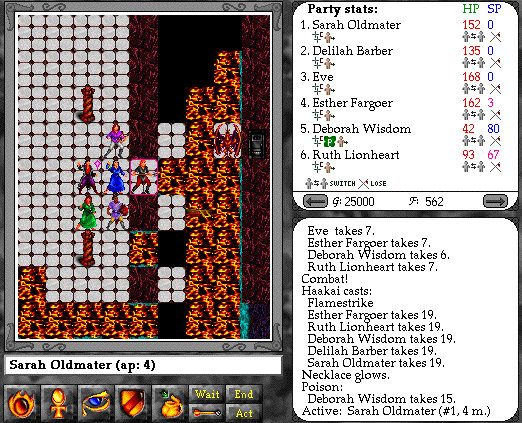
Our newest game, Geneforge 5: Overthrow, looks like this:


As you can see, I have changed just about everything. Repeatedly. Graphics. Style. Interface. And the game system underneath. Everything has been redone, and, as I learned more, redone again. And while not all of the changes have been beneficial (and were then re-changed in later games), the process has been one of evolution toward betterness.

And every change earned me angry e-mails and lost customers. I've gotten more, "Why have you forsaken me? I am lost to you forever." E-mails from customers than I could ever count. It's a depressing thing to happen when you've been really busting your butt and your budget to bring about improvements. But you have to live with it. You just have to steel yourself and always remember this:

People hate change.

Case Studies From My Own Experience

Here are some hugely beneficial (and profitable) changes I made which earned me fury and lost customers.
  • Switch From A Flat View to a 3-D Isometric View - My first games were completely flat, as seen in the first illustration. I switched to a far, far nicer pseudo 3-D isometric view in 1998. It looks better, and it enables me to do more things with the game. (Like elevations.) But, over a decade later, I STILL get complaints about it. Lost souls, out in the wilderness, wanting me to return to a design I got completely fed up with in a previous century.
  • Switch From Hand-Drawn To Rendered Graphics - Oh, wow. There are a lot of people still angry about this change, made in Avernum 4 in 2005. My old graphics were hand-drawn instead of rendered, which made any sort of animation extremely painstaking and expensive. Using 3-D models to render creatures and terrain enables me to have a wider variety of much nicer icons without crushing my budget. But it changed the look of the games that people were used to, and a lot of customers never forgave me for it.
  • Removing the Need to Identify Magic Items - A smaller but highly instructive example. Once, when you got a magic item in one of my RPGs, you had to take it to a sage to get it identified. This was busy work, confused new players, diluted the excitement of collecting lewtz, and just wasn't fun. Dropping it was a total no-brainer. And yet people complained. Why? Oh, why?
  • Removed the Need to Carry Around Ammunition For Bows - This is a recent change, part of my desire to eliminate busywork. When you shoot a bow, you just shoot it. You don't need to shop for arrows. I can see why this would break immersion for people, but it seems a neutral change at worst. Not worth the angry complaints I've gotten.
Now the more contrary among you might be thinking, "Well, maybe people complain because your so-called improvements actually suck. How about that? Huh? Huh?" Not likely. Historically, when I made major augmentations to the engine, I've seen increases in sales. If the changes I made sucked, I would not still be in business. So give me the benefit of the doubt.

And I should point out one more thing. if someone doesn't like a change, well, you can't win an argument with a customer. If they don't like it, that's their right. They'll have to find their bliss somewhere else. It is your job to make sure that your changes bring in customers to replace the ones you lose.

So What Should I, a Game Developer, Do?

Forewarned is forearmed. You can't do anything about this phenomenon, but you should steel yourself for it so you don't suffer shock, self-doubt, and potentially catastrophic second guessing.

Be sure the changes you make are worthwhile. Be sure that your community of fans is warned about them, so that the culture shock is lessened. Be apologetic but firm to the people that complain about improvements. And be confident. Remember, evolution is necessary. Making the same people happy forever is a surefire route to stagnation and burnout.

One More Thing, For Those Who Are Angry At Me Changing Things

Despite what some people think, I am constitutionally incapable of writing the same game again and again. Writing more than three games without major changes in the engine or system or setting would drive me out of my mind. I need to change the system so that I can open up new design spaces. I need to change the graphics so I don't go loopy staring at the same icons day after day.

There are some people out there who claim they would be honestly happy if I just rewrote Exile, again and again, year after year. But I can't do that. Nobody can. You should always be looking for ways to evolve your work. It'll keep you from going crazy.
Read More
Posted in advice, back in the day, design, indie, tldr | No comments

Monday, 13 April 2009

Indie Games Should Cost More, Pt. 1

Posted on 10:15 by Unknown
I have a friendly little message for my fellow Indie game designers.

You really need to start charging more for your games.

Every year, life is getting more and more expensive. Insurance. Rent. Food. And, at the same time, your games are getting cheaper and cheaper, sometimes as cheap as a dollar, as you engage in a full speed race to the bottom.

Now don't get me wrong. Some games (casual quickies, simple puzzle games) should be inexpensive. But everyone (retailers, reviewers, customers) is enabling a mindset where all games, even the niche products and larger, deeper, less casual titles, are expected to be desperately cheap. This is not going to help developers stay in business. This is not how a healthy industry is maintained.

Creating the Expectation of Insulting Cheapness

There is an increasing attitude that Indie games should be cheap. Super cheap. Like, pennies on the dollar, "How can a developer make a living that way?" cheap.

XBox Live gave the trend a big push by charging $5 or $10 for most titles. That was still enough to get rich on when the gold rush was going. It isn't going anymore. I was genuinely surprised when people seriously complained that Braid, one of the coolest, most innovative titles out last year, was an entirely reasonable fifteen bucks.

Then Microsoft created XNA, a set of tools anyone can use to write and sell games on the XBox. Sounds cool, so far, but the maximum anyone can sell their game for is $10. Not good. Think that, sometimes, some games should actually sell for more than that? You are, apparently, crazy.

Then Amazon opened their game download store, selling all titles for ten bucks or less. Not good. (Oh, and look at the comments in the article I just linked to if you don't think people are now expecting games to be that cheap.)

Now the iPhone has boldly lowered the bar, with $4.99 being the highest price point for most of the titles, and the user reviews on most $4.99 titles are about how excessively expensive they are. (As if.) And many of the games are going for ninety-nine cents. Cents! Once the gold rush is over, only the lowest budget, most casual titles are going to be able to make money at that price.

Bargain basement prices are becoming the expectation. It wasn't always that way.

A Bit of Ancient History

When I first founded Spiderweb Software, in 1994, I spent a lot of time thinking about pricing my first game, Exile. Back then, there was a good rule of thumb for pricing your shareware product:

Charge half as much as the comparable product being sold in boxes on store shelves.

Back then, new games sold for $50. So Exile was $25, which was a very common price for shareware games back then.

A few years later, I started sending the registered version on a CD (instead of E-mailing a registration code). I charged $30 for a CD. Sales changed very little.

Two years later, I went back to an E-mailed code system and lowered the price back down to $25. Sales changed very little.

Three years ago, I looked at all of our expenses (credit card fees, postage, insurance, etc) and went "Holy crap! We need to raise prices to account for this." We raised our price to $28 (still about half the price of comparable products on store shelves). Since then, our money intake has actually increased. We're doing quite well now.

And yet, in the last few years, Indie game prices have been falling through the floor. They get more and more expensive to write but are approaching unheard of levels of cheapness. ($10. $5. $1.)

So What's the Problem, Loudmouth?

Some games being sold cheap doesn't bother me. Some games SHOULD be sold cheap. Braid and World of Goo, both fantastic games, are perfectly priced at $15 for 6-7 rich, no-filler hours of play. $28 would be too much for them.

What bothers me is the increasing number of outlets where low, low prices, no matter what the quality or depth or size of the game, are the expectation. (hi2u Amazon and iTunes) This squeezes out the niche products. Niche products (like single-player RPGs, adventure games, wargames) are going to have small, intense audiences. They need to charge a fair price to survive. And that means taking all the factors into account.

How Should You Price An Indie Game?

The difference between an amateur and a professional is that the professional knows how much to charge for his or her work. When people argue about how much an Indie game should sell for, they tend to ignore several important factors that should go into the decision:
  • How Big is the Game? - Braid lasts about 6 hours, or about $2.50 an hour. A little on the pricey side, but the game gets away with it by being so fun. Our newest game, Geneforge 5: Overthrow, lasts about 30 hours, or less than a buck an hour (not counting considerable replay value). $28 seems very fair.
  • How Niche Is the Game? - Economics says that scarcer things should sell for more. A Bejeweled clone is common and thus should be cheap. Good single-player RPGs are scarce. They should sell for more.
  • How Much Do I Need To Earn To Live? - Suppose your game takes a year to write and thus, counting salaries, needs to earn about $100K to break even. If you sell it on iTunes for $.99, after Apple's cut, you need to sell around 130000 copies to break even. That is a LOT of copies. A spiffy and addictive puzzle game (which is harder to write than you think) might sell that many. A plot-heavy niche RPG? No.
When you price your game, you take the factors into account and you come up with a number. Then you try to sell the game. And if the number you need to charge is too high for what the portals will let you charge? You have a real problem. And, when good games get squeezed out of the market because of penny pinching, we all have a problem.

Indie developers are harmed by a blanket idea of what their games "should" cost. Everyone who allows this bargain basement attitude is part of the problem.

Oh, And a Quick Note For Those Who Disagree With Me ...

If you don't care about the people who work so hard to entertain you being able to charge a price that enables them to survive, I have no interest in what you have to say.

Why You Shouldn't Go Cheap, and What You, Yes You, Should Do

This is already pretty TLDR for a blog post. Next week, I'll give some of the reasons to sell games cheaply (I've heard them all over the years) and why they are bogus. And I'll give some suggestions for how everyone can maintain a market in which ALL Indies can survive.
Read More
Posted in back in the day, braid, everyone will hate this, indie, pricing, tldr | No comments
Older Posts Home
Subscribe to: Posts (Atom)

Popular Posts

  • Katawa Shoujo, Sex Stuff in Games, and Choosing What You Are Allowed To See
    What I expected: Weirdo smut. What I got: A little box full of therapy. This is one of those blog posts it's really hard to hit the Publ...
  • Avernum Out For Windows, For What It's Worth.
    A few weeks ago, Spiderweb Software finally released our newest role-playing game, Avernum: Escape From the Pit , for Windows. It's als...
  • Watch Me Talk About Something!
    Casual Connect is an annual convention in Seattle dedicated to the discussion of casual computer games, the design and marketing o...
  • Thoughts On Plants vs Zombies
    I just spent a bunch of time playing almost all of Plants vs Zombies . Then I watched my seven-year old daughter play it. She loves it. A fa...
  • The Outgoing Goblin's Guide to Gaming Etiquette
    (This is a slightly updated article I wrote for the late, lamented Dragon magazine back in the day. It is a humorous summary of all I learne...
  • Avadon Developer Diary #2 - What Sort Of Game Will This Be?
    Here is another long overdue developer diary for our next game, Avadon: The Black Fortress . These articles are about the ongoing process of...
  • Avadon Out For Windows, Responding To Critics.
    We finally released Avadon: The Black Fortress for Windows. So far, it is functional and selling very well. I am really heartened to the re...
  • Why We Need Video Game Critics, Even If the Whole Topic Is Boring
    Video games need more of this ... We've reached the point where video games have a huge place in our culture, and yet most of them are ....
  • So Here's How Many Games I Sell.
    I get a lot of questions from young, aspiring Indie developers, and the most common query is: How many copies of a game does Spiderweb Softw...
  • Shareware is dead. Long live shareware.
    The first thing I want to do in my official position as author of this blog is thank whoever first came up with the idea of using the word I...

Categories

  • 10000 hours
  • addiction
  • adolescent power fantasy
  • advice
  • android
  • apple
  • avadon
  • avernum
  • back in the day
  • bees
  • bioware
  • blatant pr
  • books
  • boring
  • both artsy AND fartsy
  • braid
  • business stuff
  • cowardice
  • criticism
  • death
  • design
  • destroying my employability in the game industry
  • developer diary
  • diablo
  • dragon age
  • drm
  • dry boring stuff
  • dungeons and dragons
  • ego-massage
  • entertaining atrocities
  • everyone will hate this
  • fad
  • fart
  • flamebait
  • flumph
  • games
  • geneforge
  • gold rush
  • grand theft auto
  • grumpy gamer
  • guitar hero
  • high-functioning alcoholics
  • humble bundle
  • humor
  • i act like i am smart
  • i am a parent if you can believe that
  • i am completely freaking out
  • i am very old
  • i hate art
  • i suck at pr
  • i've wasted my life
  • indie
  • internet hate machine
  • interview
  • introduction
  • introvision
  • ipad
  • iphone
  • jetpacks
  • l2pn00b
  • linking to things i like
  • loser
  • losing lots of money
  • mass effect
  • microsoft
  • minecraft
  • mourning
  • movie
  • nerd
  • nerdjoy
  • nerdrage
  • nethergate
  • nobel prize in awesomeness
  • not about games
  • not wrong to expect to be paid for your work
  • omigodomigodomigod
  • penny arcade
  • physical activity
  • piracy
  • ponies
  • pricing
  • pubic hair and semen
  • queen of fun
  • ranting
  • review
  • rock band
  • rpgs
  • saints row
  • sale
  • sales
  • sales figures
  • shameless self-promotion
  • shareware
  • skyrim
  • something for the ladies
  • spiderweb software
  • squid
  • ssssssss BOOM
  • star trek
  • steam
  • still alive
  • stories are for losers and squares
  • tasty meat
  • tech support
  • teh casualz
  • testing
  • that guy
  • the culture war
  • think of the children
  • tldr
  • travel journal
  • union
  • VEGAS
  • view from the bottom
  • watchmen
  • what cruddy graphics
  • whistling past graveyard
  • whomwhomwhom
  • why did my computer just melt
  • work i didn't get paid for
  • world of goo
  • xbox
  • you made my virtual pet starve you jerk
  • zombies

Blog Archive

  • ▼  2013 (18)
    • ▼  December (2)
      • Katawa Shoujo, Sex Stuff in Games, and Choosing Wh...
      • More Arguing About Women In Video Games. But This ...
    • ►  November (4)
    • ►  October (6)
    • ►  September (6)
  • ►  2012 (23)
    • ►  October (2)
    • ►  September (3)
    • ►  August (3)
    • ►  July (2)
    • ►  June (1)
    • ►  May (4)
    • ►  April (2)
    • ►  March (1)
    • ►  February (3)
    • ►  January (2)
  • ►  2011 (34)
    • ►  December (3)
    • ►  November (2)
    • ►  October (3)
    • ►  September (1)
    • ►  August (5)
    • ►  July (1)
    • ►  June (4)
    • ►  May (3)
    • ►  April (3)
    • ►  March (5)
    • ►  February (2)
    • ►  January (2)
  • ►  2010 (39)
    • ►  December (2)
    • ►  November (3)
    • ►  October (1)
    • ►  September (4)
    • ►  August (3)
    • ►  July (4)
    • ►  June (3)
    • ►  May (5)
    • ►  April (3)
    • ►  March (4)
    • ►  February (3)
    • ►  January (4)
  • ►  2009 (53)
    • ►  December (4)
    • ►  November (3)
    • ►  October (6)
    • ►  September (4)
    • ►  August (4)
    • ►  July (4)
    • ►  June (5)
    • ►  May (7)
    • ►  April (8)
    • ►  March (8)
Powered by Blogger.

About Me

Unknown
View my complete profile