Jeff-Vogel

  • Subscribe to our RSS feed.
  • Twitter
  • StumbleUpon
  • Reddit
  • Facebook
  • Digg

Friday, 11 March 2011

My Very Brief Review of Halo: Reach.

Posted on 15:16 by Unknown

Every game should have jetpacks.

(Actually, maybe a little explanation. My wife and I play every Halo and Gears of War game together in co-op. It's happy-close-couple-relationship-time.)

(Sadly, the single-player components of Halo games have gotten painfully phoned in. The kick-ass set pieces of Halo 3 have degenerated into long, tedious sequences of interchangeable roads and warehouses.)

(But Halo: Reach has JETPACKS. And that is AWESOME. For the three minutes it lets you play with them.)

(Every mission in Halo: Reach should give you jetpacks. You should be able to boing-boing-boing all over the dang place.)

(Actually, what's more, every game should have jetpacks. Dragon Age. Minecraft. Farmville. Rock Band. EVERY game.)

(Tetris should have jetpacks.)

(Jetpacks.)
Read More
Posted in adolescent power fantasy, humor, jetpacks, review | No comments

Thursday, 10 March 2011

The Whittling Part Of the Brain

Posted on 16:56 by Unknown
(One of the reasons I started this blog, besides pimping my games, was to resurrect some of my old writing that has disappeared from the face of the Earth. For example, about a decade ago, I wrote a column for the late, lamented Computer Games Magazine called The Grumpy Gamer. Here it is, only slightly updated.)

(This was the first column in that series, and, while its basic idea is simple, I still think this piece or writing is True. What still fascinates me is the way some people feel that their way of resting their brain makes them oh so superior to people who rest their brains in a different way.)


The Whittling Part Of the Brain

I have spent the last several years of my life designing computer role-playing games for a living. Thus it came to be that after a friend of mine, who designs board games for a living, couldn’t figure out why anyone found Everquest to be the slightest bit fun, he came to me for an explanation.

For those of you who haven’t experienced this particular brand of delight, most of the Everquest experience tends to involve waiting next to a place where wimpy monsters appear, waiting for them to appear, butchering them once they do appear, collecting their loot, and repeating this process until it’s five in the morning. For the uninitiated, this looks, let us be frank here, like a big waste of time.

But, when he asked me why anyone would want to do this, I had an explanation ready. It’s the same explanation I give whenever anyone asks me what the point of playing computer games is. I simply say that computer games satisfy the Whittling Part of the Brain.

Some of you, in this advanced, techmological age, may not be familiar with the concept of whittling. To whittle, you sit down with a knife in one hand and a stick (or other piece of wood) in the other. Then you take the knife and systematically proceed to carve thin slivers of wood off the stick until there’s nothing left but a pile of wood shavings and your own sense of deep self-satisfaction.

(This sounds, of course, like a pretty dubious source of entertainment, but people do some pretty bizarre things to kill time. Like watch Jersey Shore, for example.)

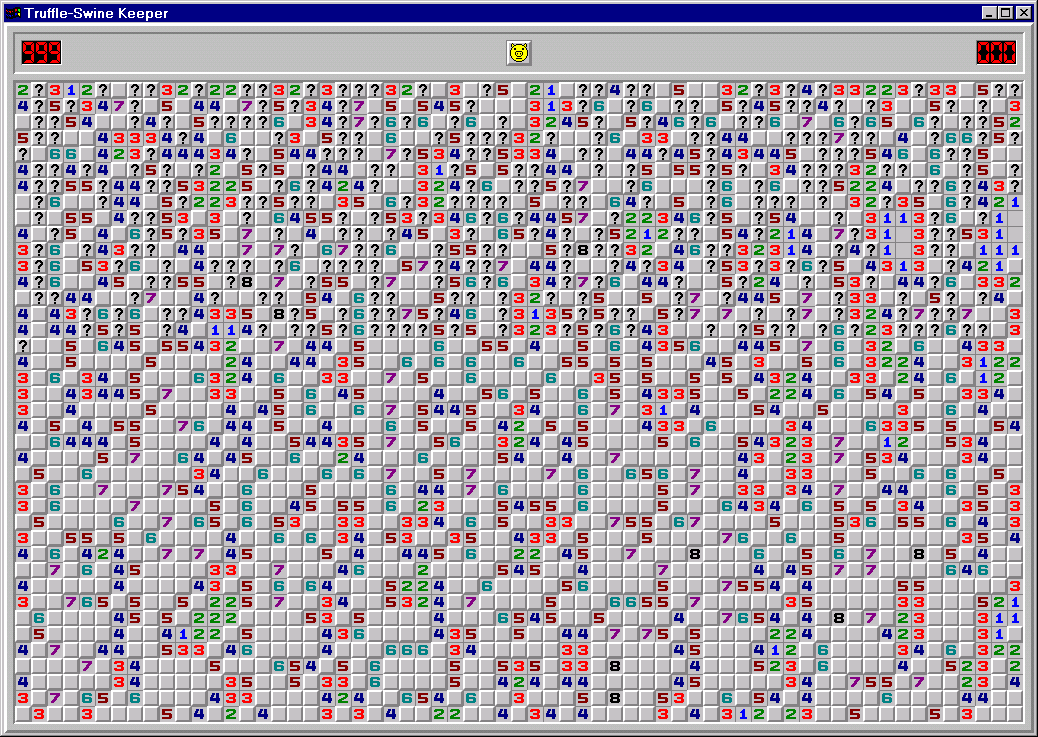
Of course, this sort of thing is what people did before computers were invented. Or televisions. Or fun. Nowadays, people can do all sorts of low-thought things to pass the time. Knitting and needlepoint. Crossword puzzles. TV. Reading mystery novels. Playing Minesweeper. And playing computer role-playing games.

The human brain just seems to have a need for resting, for passing some time in a low-energy state. Computer role-playing games are perfect for that. When I fight fifty basically identical combats against darkspawn in Dragon Age or spend five hours finally getting my level 13 druid in World of Warcraft to level 14 or piled a hundred bricks on top of other bricks in Minecraft, I’ve done more than waste my time. I’ve given by brain rest that, for reasons I can’t begin to understand, it craved.

And, of course, some of my friends think that I’m wasting my time, both designing the games and playing them. The same friends who don’t think twice about doing their five thousandth crossword puzzle, or reading basically the same damn mystery novel for the billionth time. Or read The Onion, like that’s such an enriching activity. People just like to fritter time away, and computers give us an unusually satisfying way to do it.

The most important thing about these low-brain activities is that they have to be rewarding in some way. They have to give us occasional positive feedback, little flashes of satisfaction. Sometimes, when whittling, you might carve away a particularly long and attractive spiral of wood. (Yeah. I know. Just bear with me on that one.) When knitting, you have the satisfaction of finishing your sweater. With a crossword puzzle, you feel smart when you finish.

And when playing a role-playing game, you get a constant, pleasing form of feedback in the form of gold and experience points. Or upgrading from a +1 to a +2 sword. Or getting a new spell, or completing a quest. Everquest is particularly cunning in the way it rewards the player. It has the character’s skills constantly creep upward, a tiny bit at a time, providing a constant stream of tiny rewards.

Now sure, when described this way, the whole activity sounds a little sad and lame. But really, when you think about it, if it’s such a pointless activity, why do we want to do it? I have found that, in general, our brains our smarter than we are. They want what they want, and if my brain wants to spend a while in front of a computer screen stabbing orcs, who am I to tell it it shouldn’t?

So there you go. In just the first column in this series, I’ve come up with a complete, comprehensive explanation for why it’s good and healthy and productive for us to like to play computer games. And I will recite it to myself, again and again, at two in the morning, when I’m lying awake trying to convince myself that I’m not wasting my life.
Read More
Posted in back in the day, grumpy gamer, i've wasted my life | No comments

Wednesday, 2 March 2011

Avadon: The Black Fortress Released.

Posted on 17:22 by Unknown

On Monday, after fifteen months of work, Spiderweb Software released Avadon: The Black Fortress.

I'm writing this on Wednesday, after a week spent in a pretty continuous state of total freaking out. I am always nervous when releasing a new game. But a new game in a new world with a new system? After spending an unusual amount of time on it? I've been going kind of insane.

For those who are interested, early sales are quite strong. I'm starting to suspect that we aren't about to go out of business. And yet, most of the early sales are to die-heard fans. The question is how many new people will play it and like it. I think that it's solid, the world is cool, and the game itself is a lot of fun to play. But I might be wrong. It happens all the time.

Releasing a new game also means that I have to read my forums, which, as I have written before, is painful. Even for a solid game, most of the things that are written will be critical. It's only with time that I can get a read on how good the good parts are.

This is also when I have to take the lumps for unpopular but necessary choices I had to make. The biggest complaint is that the game has no keyboard movement. Our other big series, Avernum, takes place on a fairly simple grid, so keyboard movement is easy to implement. Avadon takes place in a larger world with no simple grid for the characters to stand on, and keyboard movement just doesn't work as well as the mouse, especially for distances that aren't very short. But some people really want keyboard movement, and I can hardly tell them they are wrong. I just have to take the criticism and hope that the game is good enough.

I've also been criticized that the game text is too small, and I'm taking that to heart. I am going to work on using a larger font for dialogue and special encounters, which should help a lot.

But now I'm rambling. Releasing a game is only the beginning of a long process. Maintenance. PR. Sequels. I hope you try it out. I hope you like it. And I hope Spiderweb gets to stay in business.

On to the Windows port (hopefully out at the end of April). And the iPad port (I have no idea when this might be ready).
Read More
Posted in avadon, blatant pr, business stuff, i am completely freaking out, omigodomigodomigod, spiderweb software | No comments

Thursday, 10 February 2011

Three Rules For Difficulty In RPGs

Posted on 11:12 by Unknown

As I put the final touches on Avadon: The Black Fortress, I am finally wrapping up the most touchy, painful, contentious part of the game: play balance. Should it be harder or easier? Is this particular fight fair? How many players will wash out halfway through the game and be forever angry at me for my suckitude?

The fans of role-playing games are a pretty diverse bunch. Some prefer stories. Some fixate on stat-building. Some want to beat everything easily, and others are irritated if there are no challenges. It's a pretty amorphous blob of interests, and nobody can satisfy them all. I just try to appeal to as much of the blob as possible.

Over the years, I have made three observations regarding game difficulty. These are the ideas I always come back to as I decide how tough a given section or encounter will be. I think these guidelines are, to the extent anything can be in a creative endeavor, The Truth.

Observation One: There are two sorts of fights in an RPG: Fights that are supposed to be easy and fights that are supposed to provide a challenge.


In other words, first, there are fights that will almost never ever kill a player, also known as trash, or trash mobs. If your trash mobs are frequently killing the character, your balance is messed up. (Early versions of Avernum 6 had a big problem with this.) Most of the time, the vast majority of the fights in a game will be this sort.

Then there are fights that the player can possibly lose (mini bosses, bosses). And, of course, for fights that can kill the player, there is a spectrum of how likely that end result is. Some bosses will only kill you if you really aren't paying attention. Others require actual skill and strategy, and maybe a few tries to get your tactics down.

Observation Two: In an RPG, you have to have some of both sorts of fight.

RPG fans expect a lot of trash to slaughter, so they can be a badass and Conan-like and so they can collect experience to get strong and get new spells and swords and stuff.

The trickier part is understanding the need for tough fights. Very often, players don't like to be seriously challenged. They hate to lose. They hate to lose repeatedly. Sometimes, the temptation to just give up and have every fight on the default difficulty be easy peasy is overwhelming.

But you still need to have tough fights, for several reasons. A game full of only easy fights against trash is monotonous and dull. The suspension of disbelief in a role-playing game is delicate, and, if a dragon is only as tough as Goblin #0145, it just feels wrong. And because the adrenaline rush of achieving something difficult (be it slaying a demon lord of winning a game of solitaire) is one of the great pleasures of computer games, and you just can't lose that.

So, you might ask, why don't I just put in tough fights and really carefully balance them so that everyone can beat them in just a few tries? That brings us to the third observation, which is both subtle and vitally important.

Observation Three: If a fight has any chance of beating the player, there is a percentage of users who will NEVER be able to beat it.

It took me a long, long time to realize this. Too long. But it is vitally important to understand the difficulty of doing game balance.

Everyone has bad days. Everyone has blind spots. Some people who reach your tough fight will have used up all their healing potions, or refuse to use the healing potions, or forget that they have healing potions, or never have realized that healing potions are potions you can drink that heal you. Because of this, whenever people reach a tough fight, there will be a few of them who just can't beat it. They just can't. You can adjust the percentage of people who lose, but it will never be zero.

(By the way, along these lines, if you put any puzzle or riddle in a game, there is a percentage of users who will never figure it out. This is why I've drastically reduced the number of puzzles in my games. Arguably, I have reduced it too much. It bears thinking about. However, this is my rationale for doing it.)

When someone loses to a fight more than three or four times, they will almost always be angry, and they will always blame you. Some of them will temporarily lower the difficulty, get past the fight, and move on. Some will gut it out and prevail. And some will ragequit and you will never sell a game to them again.

I try to appeal to a wide group of customers, but there is one customer I can never appeal to: The gamer who can't beat a fight and refuses to lower the difficulty. I get e-mails from this person all the time, expressions of hurt and betrayal and rage, accompanied with the promise that they will never buy another one of my games. A promise I believe, by the way. I hate getting these e-mails. Everyone does. It's like a punch in the stomach. But I suck it up, send a nice message back, and move on. It's like death and taxes. It's part of the biz.

But, with every difficult encounter, I eventually have to plant my flag and say, "You must be at least this badass to go on this ride." If you aren't sure why I do this, please consult with the reasons accompanying Observation Two.

Of Course, These Aren't Universal Laws

I expect that the standard swarms of hair-trigger internet nitpickers haven't read this far. They went to the Comments to excoriate me based on some minor point about Observations One or Two, or they want me to explain how Shadow of the Colossus can be a good game with only boss fights. (Answer: Not an RPG.)

But role-playing games are a genre. Genres have conventions. That's what makes them Genres! I can go along with the conventions or fight against them, but, either way, they are part of the DNA of the games I make.

Role-playing games need trash and they need bosses. Put both in, and never lose sight of what makes trash trash and what makes bosses bosses.
Read More
Posted in avadon, design, teh casualz, testing | No comments

Tuesday, 1 February 2011

Shameless Self-Promotion.

Posted on 11:51 by Unknown

The gaming site GameBanshee was kind enough to call our newest game, Avernum 6, in their annual awards. We were runner-ups in the Independent RPG of the Year and RPG Game of the Year categories. Thank you very much!

This sort of thing is exciting to me, and not just because of the obvious self-esteem and greed motivations. The recession has been really rough on the gaming press, and, because of that, it's been rough on us. Many of the writers and editors who liked to cover us lost their jobs, and many of the small news outlets that were willing to cover humble Indie games like ours disappeared or were absorbed. It's been depressing.

The hardest part about being a small Indie is getting attention. Press coverage is oxygen. It takes the tenacity of the cockroach to eventually find editors who are willing to say, "Sure, they're small, but I believe in what they're doing. I'm going to back them up." And, when it happens (such as the recent coverage of us in PC Gamer), I'm incredibly grateful.
Read More
Posted in avernum, blatant pr, shameless self-promotion, spiderweb software | No comments

Tuesday, 25 January 2011

Avadon Developer Diary #5 - Getting It Done.

Posted on 13:57 by Unknown

This will probably be the last developer diary for Avadon: The Black Fortress. We hope to release it for the Macintosh at the end of February. Then the process of porting it to Windows and the iPad shall commence. Of course, I could get the flu or be hit by a truck, which will alter the release schedule slightly.

The first preview of Avadon recently appeared on Inside Mac Games. There's a lot of good information there.

I've already written diaries about the origin of the game, the tone, the sorts of decisions that need to be made, and the character classes. For me, the longest, most grueling part of writing the game is making the scenario. Dungeons have to be designed. Dialogue needs to be written. Gold coins, clay pots, and spoons need to be placed. In other words, the game itself needs to be made.

That process finally ended last week, meaning that we're in the endgame. Time to wrap up all the odd details and kick the game out the door! This is what I generally call the OHGODOHGODITBURNSGETITOFFMEGETITOFFMEEEEEEEEE phase.

This process, during which everyone involved is pretty much running off fumes, has several parts: Odds and Ends, Endgame Balance, Bug Fixing, and Getting the Game Stable.

Odds and Ends

There are always lots of aggravating parts of the job of writing a game that I put off and put off. Now they can't be put off anymore. Every job I hate. Doing the sound effects. And writing the documentation (and hint book). And making the game icon, and the installer. Nothing can be delayed anymore.

A lot of this work is very important, as they determine a player's first impression. Things like the icon and the starting music and art are the first things a player will experience. These details require a lot of attention, so I work on them at a time when I can focus on them as much as possible.

For Avadon, I've put a lot of work into directing the art at the beginning of the game so that they help the player understand a complicated world, with a lot of intricate politics. The early moments of the game can't be wasted. I want to intrigue the player with the story at every possible moment.

Endgame Balance

Balancing the end of the game is particularly difficult. There are several reasons for that. First, there is a wide spread in power levels among players. The dedicated grinders and min-maxers have made characters that are about as powerful as the game allows. More casual players have characters who have fallen farther and farther behind. An encounter that is challenging to a hardcore player will be impossible for a casual player, and an encounter that is tough for a casual player is probably painfully easy for the serious player.

It's a very difficult target to hit, complicated by the fact that at least some of the epic battles at the end of the game should have some pushback to them. They should feel a little tough.

So I try to make the late game fights hard but not impossible for the more casual players. I also try to put in some optional endgame fights that are a real challenge for the toughest players. These two targets are actually tricky to hit precisely, and it requires a lot of feedback and rebalancing.

In Avadon, I want the player to be able to challenge Redbeard for control of the Black Fortress. I want this fight to be soul-crushing, but, with great skill, preparation, and luck, winnable. This is an extra-difficult target to hit. Making something almost impossible is hard. Still, I think I'm getting close.

Bug Fixing and Getting the Game Stable

Of course, this should happen. Now that the game is mostly done, I am getting to the point where everything has been tested and is basically playable. Now that I am trying to actually release the game, I am trying to get it to the most stable, functional point I possibly can.

It's tricky, because Avadon has a lot of player decisions that can make big changes in the ending. Fortunately, my industrious beta testers are doing a great job of trying out all the different possibilities.

This is actually a much more complicated process than it sounds. You see, whenever I make a change, even the most seemingly tiny, innocuous change, there is a chance that I just broke everything.

Games Are Like Giant Cubes of Jello

One of my favorite books on software development describes an unshipped piece of software as a ten by ten by ten foot cube of jello. When you finish it, it is wobbling and shaking. Then, slowly, the vibrations stop and it becomes stable. However, whenever you poke the jello, it starts to wobble again and it takes a long time to become still.

Avadon is a huge cube of jello that is wobbling like mad. As testers play it and don't find serious problems, it stops wobbling. When I make a change, any change at all, I poke it. When the jello is almost still, I go, "OK, I will release the game ... NOW!" and hope it isn't broken. This is how the process works at its best.

So fixing bugs now is a process of triage. When I get a bug report, I think, "Is this serious enough to risk fixing it, bearing in mind that my fix might completely mess up the game?" As we get closer and closer to the ship date, more and more minor issues get kicked off to the v1.0.1 release.

If you've ever wondered why games ship with bugs, this is part of the answer. There is no excuse for releasing a broken game. However, small flaws are always tolerated in order to avoid disaster. Perfection is for v1.0.4.

So Back To Work

If you've been reading these diaries, thank you! I hope I made Avadon sound interesting, and I hope the game is to your liking. It's been a very long road. I've put a lot of myself into this game, and it really is the sort of game I would want to play. Thus, if it turns out to be a failure, I'll have a lot of thinking to do.

Thanks for reading, and I'll see you on the flip side!
Read More
Posted in avadon, developer diary, shameless self-promotion, spiderweb software, testing | No comments

Wednesday, 5 January 2011

Three Reasons Creators Should Never Read Their Forums

Posted on 21:42 by Unknown
If I have learned anything from writing Indie games for a living for fifteen years (and there are plenty who would say that I haven't), it is that it is usually a bad idea for creators to visit online forums discussing them and their work. It doesn't lead to happy ends.

This is why big, smart companies with actual budgets hire community people who do nothing but deal with and sift through forums. Managing fans is real work, and picking out the realistic and worthwhile comments takes a ton of time and judgment. That is why smart companies put a layer between the fans and the creators. If you don't have this layer, you should keep a safe, respectful distance.

It's a pity. My company, Spiderweb Software, has a really awesome, active online forum. Been there for years. Always active, full of all sorts of discussions. However, unless I've just released a game and are looking for signs of early, evil bugs, I have to stay away from it.

Some of my fans really resent this and take it personally, and they haven't been shy about letting me know. But if you've ever wondered why the creators of your beloved games often avoid the forums (especially the Word of Warcraft forums, Yeesh!), this might help you to understand why.

1. It's Not Productive To Read How Much People Hate You

It's been said that, if you want a healthy marriage, you have to say five kind things for every unkind thing. It is in our nature to gloss over and ignore kind words, but to really fixate on and get affected by unkind ones. This is why Facebook will never have a Don't Like button. If you see "Joe likes your post," well, fine. If the average online denizen see "Joe doesn't like this," he or she will probably freak out.

Which brings us to forums.

A few years ago, I wrote an article for IGN about how I felt that Indie games were far from the only source of innovation, and the big companies don't get enough credit for trying to make innovative things. Slashdot was kind enough to link to it. Someone might agree or disagree with me. Fine. But someone wrote this ...

"This is the kind of commentary I'd expect out of a cynical independent ripoff artist in action, really. You know, the kind of person who is too afraid and closed-minded to try anything new, partly because he doesn't want to lose his money or reputation - a sound judgement - and partly because he just doesn't seem to want to try. ...  In other words, nothing to see here. Just near-mindless droning from another cynic with a rather skewed and defeated view of the gaming world."

WHOA! DUDE! What did I ever do to you? Did I run over your dog? Make out with your mom? Go to where you work and mess up the settings on the fry vat? Damn!

Now, I thought that one was pretty funny. I sent links to it to my friends, saying, "Hey! Look what people REALLY think of me!" Over the years, I've developed a pretty thick skin. And yet, if you read lots of people dumping on you, unless you have super-human emotional control, it's eventually going to get to you. Sometimes I'll get weak and look at a forum and see some nasty cheap shot and it'll throw me off my game for hours.

Remember, as Penny Arcade put it (in a far superior and NSFW way), anonymity plus audience makes assholes. (And, for what it's worth, the creators of Penny Arcade don't read their forums either.)

It's a little different on my company's forums. But only a little. Even though it is mainly populated by my fans, it is still full of shots at my design skill, game quality, virility, and facial complexion. Remember, there's a thin line between love and hate. Nobody will lash out at you like a disappointed fan.

When I read the forums for, say, World of Warcraft or xkcd, I'm always amazed at how nasty things get. It makes me think, "If you hate it so much, why are you there?" But that's just the way it is, and excess exposure to insults can really get under your skin, make you doubt yourself, and interfere with your work. It's very sad, but you sometimes need to just protect yourself by staying away. Keep your brain clean.

2. It's Not Going To Be Helpful

It seems like reading forums would be a good way to get design ideas and learn ways to improve your games. With the exception of learning about bugs, this is usually not the case.

It can be tempting, when you're stuck designing a game, to read forums and look for feedback. The problem is this. No matter what the question is, there are people who will advocate strongly for both sides of it. Many of these people reflexively hate change. Many of these people are only happy if the game is much harder (or much easier). Some of them will not, in fact, have a realistic idea about anything. Often, there are issues where intelligent people can come to opposite conclusions, and you can read thousands of furious posts on either side of the issue without getting an inch closer to an actual decision.

Forums contain a cacophony of people telling you to do diametrically opposite things, very loudly, often for bad reasons. There will be plenty of good ideas, but picking them out from the bad ones is unreliable and a lot of work. If you try to make too many people happy at once, you will drive yourself mad. You have to be very, very careful who you let into your head.

Of course, it is still very important for designers to get lots of good, constructive criticism. That is why I have built up an elite cadre of awesome beta testers and interested friends, and I listen to them very closely. And, I must point out, many of those testers were recruited from my forums. You just need to choose carefully the people you ask for advice.

3. You Might Get Suckered Into Getting Angry

Not much to say about this. If you read forums for long enough, you will read a lot of nasty comments and cheap shots. If you read enough cheap shots, you'll get angry. If you are angry enough, you will eventually lash out and flame back.

Snapping angrily at your customers never, ever leads to good results.

One Final Comment

I'm sure some of my fellow Indie developers are reading this and shaking their heads at my idiocy. A lot of developers do maintain close relationships with their forums. It works for them, for now. I'm glad for them, and I hope it keeps working.

Just bear this in mind. When you start out and gain your first following, you get a grace period. You're a fresh face, making awesome new things. Everyone loves you. And, most importantly, you haven't had a chance to start disappointing chunks of your fan base yet.

The longer you are active, the more of your fans will turn on you, justified or not.

And, if you are a member of my forums reading this, know this. I love you guys. The idea that anyone wants to discuss my work at all, even to dump on it, is insanely flattering. I just hope that this makes clearer the instincts of efficiency and self-preservation that lead me to keep a little bit of distance.

Edit: Changed "think skin" to "thick skin."
Read More
Posted in advice, cowardice, everyone will hate this, i suck at pr, indie, tldr | No comments
Newer Posts Older Posts Home
Subscribe to: Posts (Atom)

Popular Posts

  • Katawa Shoujo, Sex Stuff in Games, and Choosing What You Are Allowed To See
    What I expected: Weirdo smut. What I got: A little box full of therapy. This is one of those blog posts it's really hard to hit the Publ...
  • Avernum Out For Windows, For What It's Worth.
    A few weeks ago, Spiderweb Software finally released our newest role-playing game, Avernum: Escape From the Pit , for Windows. It's als...
  • Watch Me Talk About Something!
    Casual Connect is an annual convention in Seattle dedicated to the discussion of casual computer games, the design and marketing o...
  • Thoughts On Plants vs Zombies
    I just spent a bunch of time playing almost all of Plants vs Zombies . Then I watched my seven-year old daughter play it. She loves it. A fa...
  • The Outgoing Goblin's Guide to Gaming Etiquette
    (This is a slightly updated article I wrote for the late, lamented Dragon magazine back in the day. It is a humorous summary of all I learne...
  • Avadon Developer Diary #2 - What Sort Of Game Will This Be?
    Here is another long overdue developer diary for our next game, Avadon: The Black Fortress . These articles are about the ongoing process of...
  • Avadon Out For Windows, Responding To Critics.
    We finally released Avadon: The Black Fortress for Windows. So far, it is functional and selling very well. I am really heartened to the re...
  • Why We Need Video Game Critics, Even If the Whole Topic Is Boring
    Video games need more of this ... We've reached the point where video games have a huge place in our culture, and yet most of them are ....
  • So Here's How Many Games I Sell.
    I get a lot of questions from young, aspiring Indie developers, and the most common query is: How many copies of a game does Spiderweb Softw...
  • Shareware is dead. Long live shareware.
    The first thing I want to do in my official position as author of this blog is thank whoever first came up with the idea of using the word I...

Categories

  • 10000 hours
  • addiction
  • adolescent power fantasy
  • advice
  • android
  • apple
  • avadon
  • avernum
  • back in the day
  • bees
  • bioware
  • blatant pr
  • books
  • boring
  • both artsy AND fartsy
  • braid
  • business stuff
  • cowardice
  • criticism
  • death
  • design
  • destroying my employability in the game industry
  • developer diary
  • diablo
  • dragon age
  • drm
  • dry boring stuff
  • dungeons and dragons
  • ego-massage
  • entertaining atrocities
  • everyone will hate this
  • fad
  • fart
  • flamebait
  • flumph
  • games
  • geneforge
  • gold rush
  • grand theft auto
  • grumpy gamer
  • guitar hero
  • high-functioning alcoholics
  • humble bundle
  • humor
  • i act like i am smart
  • i am a parent if you can believe that
  • i am completely freaking out
  • i am very old
  • i hate art
  • i suck at pr
  • i've wasted my life
  • indie
  • internet hate machine
  • interview
  • introduction
  • introvision
  • ipad
  • iphone
  • jetpacks
  • l2pn00b
  • linking to things i like
  • loser
  • losing lots of money
  • mass effect
  • microsoft
  • minecraft
  • mourning
  • movie
  • nerd
  • nerdjoy
  • nerdrage
  • nethergate
  • nobel prize in awesomeness
  • not about games
  • not wrong to expect to be paid for your work
  • omigodomigodomigod
  • penny arcade
  • physical activity
  • piracy
  • ponies
  • pricing
  • pubic hair and semen
  • queen of fun
  • ranting
  • review
  • rock band
  • rpgs
  • saints row
  • sale
  • sales
  • sales figures
  • shameless self-promotion
  • shareware
  • skyrim
  • something for the ladies
  • spiderweb software
  • squid
  • ssssssss BOOM
  • star trek
  • steam
  • still alive
  • stories are for losers and squares
  • tasty meat
  • tech support
  • teh casualz
  • testing
  • that guy
  • the culture war
  • think of the children
  • tldr
  • travel journal
  • union
  • VEGAS
  • view from the bottom
  • watchmen
  • what cruddy graphics
  • whistling past graveyard
  • whomwhomwhom
  • why did my computer just melt
  • work i didn't get paid for
  • world of goo
  • xbox
  • you made my virtual pet starve you jerk
  • zombies

Blog Archive

  • ▼  2013 (18)
    • ▼  December (2)
      • Katawa Shoujo, Sex Stuff in Games, and Choosing Wh...
      • More Arguing About Women In Video Games. But This ...
    • ►  November (4)
    • ►  October (6)
    • ►  September (6)
  • ►  2012 (23)
    • ►  October (2)
    • ►  September (3)
    • ►  August (3)
    • ►  July (2)
    • ►  June (1)
    • ►  May (4)
    • ►  April (2)
    • ►  March (1)
    • ►  February (3)
    • ►  January (2)
  • ►  2011 (34)
    • ►  December (3)
    • ►  November (2)
    • ►  October (3)
    • ►  September (1)
    • ►  August (5)
    • ►  July (1)
    • ►  June (4)
    • ►  May (3)
    • ►  April (3)
    • ►  March (5)
    • ►  February (2)
    • ►  January (2)
  • ►  2010 (39)
    • ►  December (2)
    • ►  November (3)
    • ►  October (1)
    • ►  September (4)
    • ►  August (3)
    • ►  July (4)
    • ►  June (3)
    • ►  May (5)
    • ►  April (3)
    • ►  March (4)
    • ►  February (3)
    • ►  January (4)
  • ►  2009 (53)
    • ►  December (4)
    • ►  November (3)
    • ►  October (6)
    • ►  September (4)
    • ►  August (4)
    • ►  July (4)
    • ►  June (5)
    • ►  May (7)
    • ►  April (8)
    • ►  March (8)
Powered by Blogger.

About Me

Unknown
View my complete profile